What Is a Website Conversion? A Simple Guide for Small Business Owners
You launched your website. It looks cute. Your links work. Your mum said she loves it. But is it actually doing anything?
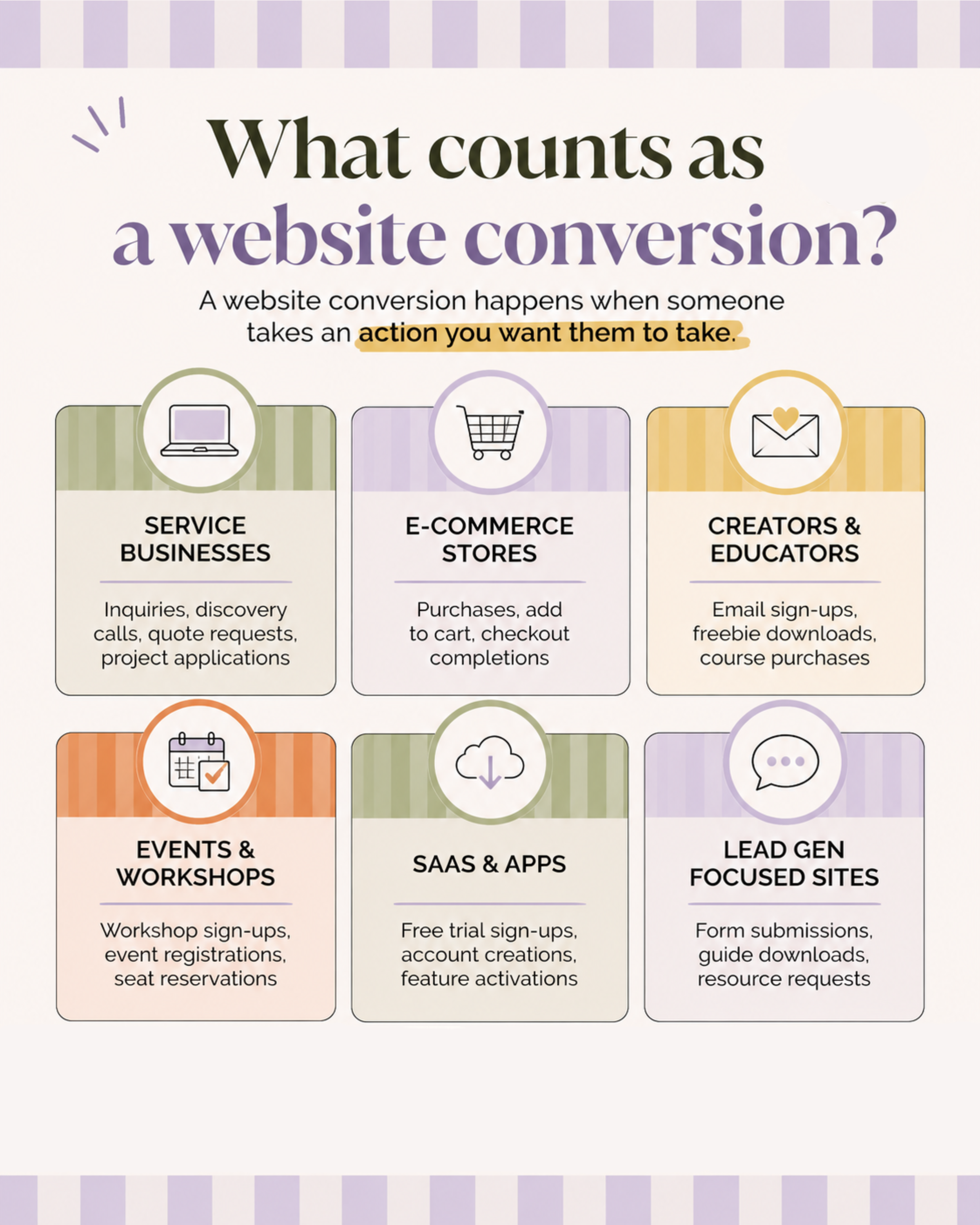
If you've been wondering what is a website conversion, here's the simple answer: a website conversion happens when a visitor completes an action you want them to take, such as making a purchase, joining your email list, booking a call or submitting an inquiry.
Because getting people to your website is only half the job. Once they arrive, ideally, you want them to do something other than admire your font choices for 14 seconds and disappear back into the internet.
And while “website conversion” sounds like one of those marketing terms that requires three dashboards, a spreadsheet and a man on LinkedIn explaining funnels to you, it’s actually pretty simple.
So, let’s talk about what is a website conversion, how to calculate your conversion rate, how website conversion tracking works, what average website conversion rates can tell you and which numbers are actually worth paying attention to.
What Is a Website Conversion?
A website conversion happens when someone visits your website and completes an action you want them to take.
That’s it.
And no, a conversion doesn’t necessarily mean someone buys something. What counts as a conversion depends entirely on what you want your website to do.
For example, a website conversion could be someone:
buying a product
booking a discovery call
filling out your inquiry form
joining your email list
downloading your free resource
signing up for a workshop
starting a free trial
requesting a quote
If you’re a service provider, your main website conversion might be an inquiry. If you run an online shop, it’ll probably be a purchase. If your website’s main job is growing your email list, a new subscriber might be the conversion you care about most.
So, when someone asks what is a website conversion, there isn't one universal action that counts.
What Are Micro-Conversions and Macro-Conversions?
Website conversions can also be divided into two categories: micro-conversions and macro-conversions. I know. More marketing terminology. Stay with me.
A macro-conversion is the bigger end goal you ultimately want someone to complete.
For example:
Service business: Sending an inquiry
Online shop: Making a purchase
Membership: Becoming a paid member
SaaS business: Starting a paid subscription
A micro-conversion is a smaller action someone takes on the way there.
That might look like this:
Service business: Visiting your services page → reading a case study → clicking “Work with me” → sending an inquiry
Online shop: Viewing a product → adding it to their cart → starting checkout → purchasing
Those smaller actions matter because most people don’t arrive on your homepage and immediately throw their credit card at you.
They look around. They read. They compare. They silently judge whether your website looks like it was last updated in 2007. They figure out whether they trust you. And then they decide what to do.
Understanding both types of conversions gives you a much clearer picture of what visitors do between arriving on your website and completing your main goal. That becomes particularly useful once you start website conversion tracking, because instead of only seeing the final result, you can look at the journey leading to it.
Calculating Your Website Conversion Rate
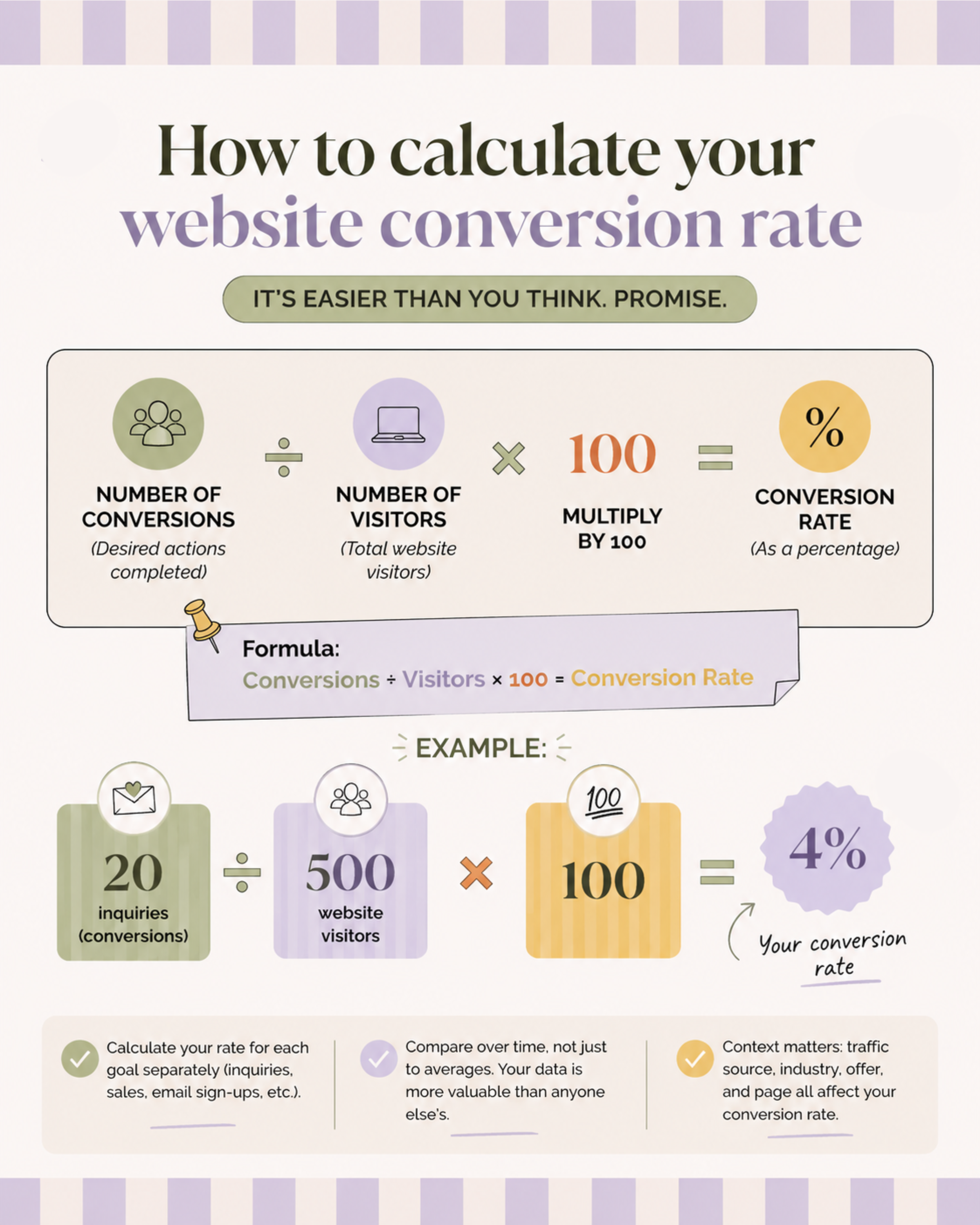
A website conversion rate is the percentage of website visitors who complete the specific conversion action you're measuring.
So rather than only knowing that 10 people inquired about your services this month, your conversion rate puts those 10 inquiries into context.
Because 10 inquiries from 100 website visitors? bVery different situation from 10 inquiries from 100,000. Your conversion rate helps you see that difference.
This is also why understanding what is a website conversion comes before obsessing over your conversion rate. You need to decide what action you're measuring before that percentage means anything.
How Do You Calculate Your Website Conversion Rate?
Thankfully, this does not require the maths skills I abandoned somewhere around ninth grade.
The basic formula is:
Number of conversions ÷ number of visitors × 100 = conversion rate
Let’s say 500 people visit a landing page and 20 of them fill out your inquiry form.
20 ÷ 500 × 100 = 4%
Your conversion rate for that action would be 4%.
You can calculate conversion rates for different actions separately, too.
For example, you might track:
what percentage of homepage visitors join your email list
what percentage of service-page visitors submit an inquiry
what percentage of sales-page visitors buy
what percentage of visitors click through to your booking page
The important part is knowing exactly which conversion you're measuring and using a relevant group of visitors when calculating it.
All About Website Conversion Tracking
Website conversion tracking is the process of measuring the actions visitors complete on your website so you can see how effectively your site supports your business goals.
Instead of thinking: “Hmm. People visit my website. I think? Hopefully?” You can actually see what happens.
Depending on your website, business and goals, website conversion tracking might include monitoring:
purchases
submitted forms
booked calls
email sign-ups
downloads
important button clicks
checkout completions
visits to key pages
Tools such as Google Analytics can be configured to measure important website events and conversions. Your website platform, booking software, email platform or ecommerce system may also give you useful conversion data.
But before you start tracking every click like you’ve recently joined the FBI, decide which actions actually matter to your business. Because more data isn’t automatically better data.
If your main goal is getting potential clients to inquire, knowing that 63 people clicked a random footer link probably isn't going to revolutionize your business. Knowing how many people visited your service page versus how many submitted the inquiry form? Much more useful.
Good website conversion tracking focuses on meaningful actions, rather than collecting numbers simply because your analytics platform lets you.
Why Does Website Conversion Tracking Matter?
Website conversion tracking helps you understand whether visitors are taking the actions your website was created to encourage.
Traffic alone doesn't tell you whether your website is working. You could get 5,000 website visitors this month and feel pretty damn pleased with yourself. But if nobody joins your list, submits an inquiry, books a call or buys anything… those 5,000 visitors aren't doing much for your business. On the other hand, a smaller website attracting the right people and guiding them toward a clear next step could be doing a fantastic job.
Website conversion tracking gives your traffic numbers context.
It can help you investigate questions like:
Are people visiting but not taking action? (There could be something on the website creating friction or confusion)
Are lots of people visiting one service page but barely anyone inquiring? (That page might need some attention)
Are people signing up for your freebie but never moving toward your paid offers? (You may need to look beyond your website at what happens next)
Did conversions increase after you changed your messaging? (Okayyy. Now that is useful information!)
Notice that I said these numbers can help you ask better questions, not magically answer every question for you.
A low conversion rate doesn't automatically mean your copy sucks. It could be your copy. It could also be your offer, traffic quality, user experience, pricing, website speed, broken forms, audience targeting or approximately 742 other things.
Numbers give us clues. Then we investigate.
What Are Average Website Conversion Rates?
Average website conversion rates are benchmark percentages showing how frequently website visitors complete a particular desired action, usually across an industry, channel or type of conversion.
And here we arrive at the question everyone secretly wants answered: “Okay, but what is everyone else getting?” Fair.
You'll find plenty of studies reporting average website conversion rates, and broad benchmarks often sit somewhere in the low single digits.
The global average website conversion rate typically ranges between 1.84% and 3.71% for ecommerce, while broader multi-industry site benchmarks land closer to 2.35% and 5.31% (source).
However, there is no single average that meaningfully applies to every website, because conversion rates change dramatically depending on the action being measured and the context around it. Different industries, reports and analytics companies also use different datasets and definitions. Very convenient. Love that for us.
Your conversion rate can vary based on:
your industry
what you're selling
your price point
where your traffic comes from
how familiar visitors already are with you
the page they're visiting
the action you're asking them to take
whether they're ready to buy yet
Even two businesses offering similar services could have wildly different conversion rates because one gets most of its traffic from warm email subscribers while the other gets thousands of cold visitors through Google.
So, use average website conversion rates as context, not as a universal standard your website has somehow failed to meet.
What’s a Good Website Conversion Rate?
A good website conversion rate is one that supports your business goals, reflects the type and quality of traffic you receive, and performs well relative to relevant benchmarks and your own historical data.
I know you wanted one magic number. I know.
Broad industry benchmarks can still be useful. They give you something to compare against and can help you notice when something seems unusually high or low. But they are a benchmark, not a report card.
If some article tells you the average conversion rate is 3% and yours is 2.4%, please don't immediately schedule a funeral for your website.
First, make sure you're comparing the same type of conversion. Looking at average website conversion rates is most useful when the benchmark is genuinely comparable to your business: similar industry, similar conversion action and ideally a similar type of traffic. Then look at your own data.
What was your conversion rate six months ago?
Which pages convert better than others?
Which traffic sources send you visitors who actually take action?
What happens when you change your headline, CTA or offer positioning?
Your own numbers can often tell you far more than a random internet average ever will.
A Higher Website Conversion Rate Isn't Always Better
Let's say you make your messaging extremely broad because you want more people to inquire.
Your inquiry conversion rate shoots up. Yay?
Except now you're spending half your week answering messages from people who aren't remotely right for your services.
Technically, you increased conversions. Business-wise, you created yourself a new unpaid administrative position.
This is especially important for service providers.
The goal isn't necessarily to get the highest possible number of conversions. It's to get more of the right conversions.
I'd rather see your website bring you five inquiries from people who understand what you do, value your work and are genuinely interested than 25 inquiries asking whether you'll do the whole project for $47 and “exposure.” Quality matters too.
And that's another reason what is a website conversion needs to be answered in relation to your specific goals. A conversion is only valuable when the action itself is valuable to your business.
Your website conversion rate doesn't exist in a vacuum This is probably the biggest thing I want you to take away from this article.
What Actually Influences Website Conversions?
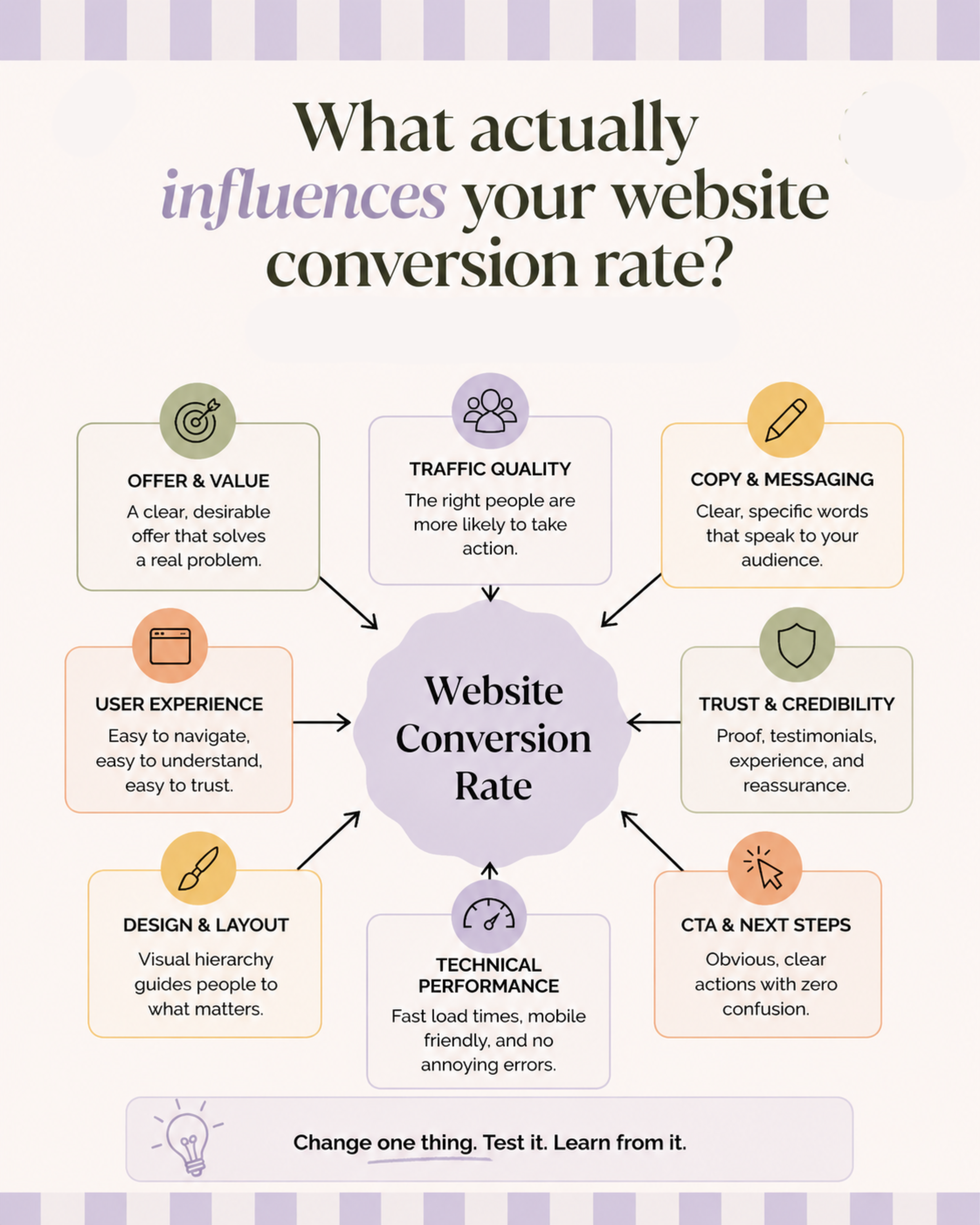
Website conversions are influenced by factors including traffic quality, your offer, copy and messaging, design, user experience, trust, technical performance and how clear the next step is.
Because getting more website conversions isn't just about changing your CTA from blue to orange and waiting for your bank account to start applauding.
People need to understand what you do. They need to know whether it's for them. They need enough information to make a decision. They need to trust you. They need to understand what happens next. And ideally, your website shouldn't make accomplishing that task feel like an escape room.
Your copy, messaging, design, user experience, offer, traffic and calls to action all play a role.
The Takeaway
If you came here asking what is a website conversion, here's the part worth remembering: a website conversion is a meaningful action a visitor completes on your site, while your website conversion rate measures the percentage of visitors who complete that action.
Figure out what a conversion actually means for your website. Choose the actions worth tracking. Set up website conversion tracking around those actions. Get enough data to make your numbers meaningful. Use average website conversion rates as context, not commandments carved into a marketing stone tablet.
And remember that the goal isn't simply to convince more random humans to click a button. It's to make your website clearer, easier and more useful for the people you actually want to work with.
Because yes, conversion rates matter.
But the humans doing the converting matter a hell of a lot more.
And if you've figured out what your conversion rate is and your immediate next thought is, “Cute. Now how do I improve it?”
Good news.
That's exactly what we're talking about next, so stay tuned.