How to Make Blog Content Part of Your Marketing Strategy in 2026
Blogging is one of the most underrated marketing tools available to small businesses. When done well, a blog content marketing strategy can support your SEO, improve your visibility in AI search tools, generate content for social media and help potential customers discover your business long before they're ready to buy.
Yet a lot of business owners are still treating their blog as a separate marketing task instead of an important part of their overall strategy.
Which is a shame because a blog can do a lot more than simply sit on your website looking pretty.
One strategic blog post can support almost every part of your marketing. It can help people discover your business through Google. It can help AI tools understand what you do. It can give you content for social media, Pinterest and newsletters. It can build authority, answer customer questions and guide people toward your services.
But the problem is that most business owners aren't using their blogs strategically. Let's fix that.
Why Long-Form Content Still Matters in 2026
One of my favorite internet myths is: "Nobody reads blogs anymore."
Really?
Then why are people spending three hours listening to podcasts about productivity? Why are they watching 45-minute YouTube videos about topics so niche they sound completely made up? Why are they reading Reddit threads longer than some university dissertations?
Humans haven't stopped consuming long-form content. They've stopped consuming boring content.
People absolutely read when:
they're trying to solve a problem
they're researching a purchase
they're looking for advice
they're comparing options
they're curious about something
Think about your own behavior.
When you need a quick dinner recipe, maybe you watch a Reel. But when you're trying to choose a therapist, website designer, nutritionist, copywriter or photographer? You're probably doing a little more research than watching a 12-second video with trending audio.
This is exactly why a blog content marketing strategy still matters.
Blogs allow you to provide:
depth
context
expertise
examples
perspective
Things short-form content simply doesn't have room for.
As the internet gets noisier, thoughtful long-form content becomes more valuable, not less.
While everyone else is competing for attention in increasingly chaotic ways, your blog is quietly building trust.
So… How to Make Blog Content Part of Your Marketing Strategy?
1. Stop Treating Your Blog Like a Side Project
If you're treating your blog like that forgotten vegetable drawer in your fridge, we need to talk.
A lot of businesses approach blogging like this: "I should probably write a blog since I have an extra hour today." Then they open a Google Doc, write something vaguely related to their industry and call it a day.
That's not a blog content marketing strategy.
A strategic blog serves a purpose. Actually, several purposes.
Here's the difference:
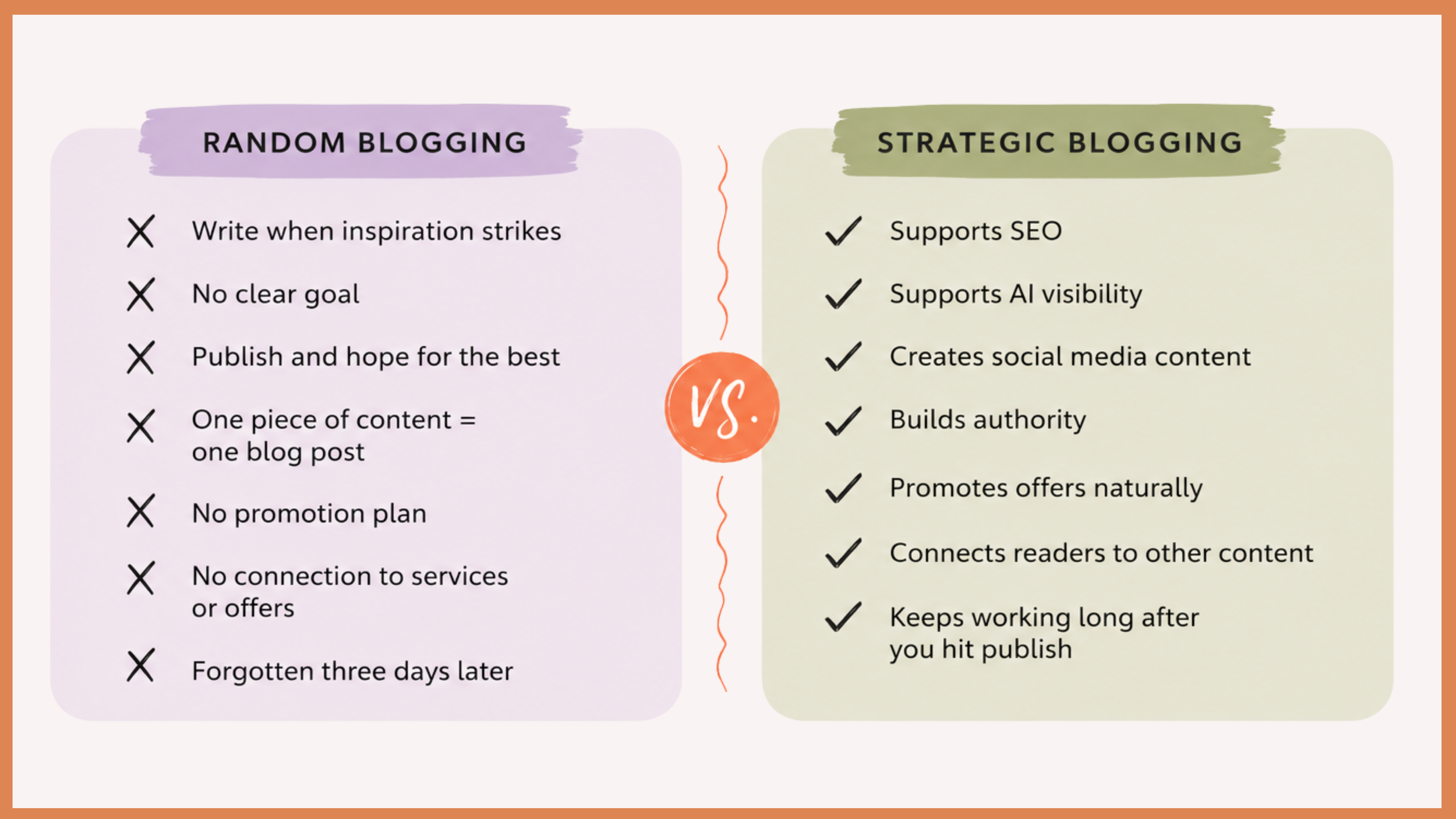
A strong blog content marketing strategy should support:
SEO
AI visibility
authority building
social media content
content repurposing
service promotion
audience education
2. Use Blog Content to Improve SEO and AI Visibility
Let's address the elephant in the room:
Yes, people still Google things.
I know. Very controversial statement in 2026.
Every year somebody declares SEO dead and every year businesses continue getting traffic from search engines. But here's what's actually changing:
People aren't only using Google anymore. They're also asking ChatGPT, Claude and Gemini questions every day.
Things like:
"What's the best way to market a small business?"
"How do I improve my sleep?"
"What should I look for when hiring a wedding planner?"
And where do these tools get information from?
Websites. Articles. Resources. Blogs.
This is one of the biggest reasons a blog content marketing strategy matters more than ever right now.
Your blog isn't just helping Google understand your business, it's helping AI understand your business too.
For example:
Let's say you're a therapist in Los Angeles.
Someone asks ChatGPT: "Can you recommend a therapist in Los Angeles who specializes in anxiety?"
If your website clearly explains who you help, what services you offer, where you're located and what topics you specialize in, you have a much better chance of appearing in relevant conversations.
The same goes for blog content.
If somebody asks: "How can I manage anxiety naturally?"
AI tools may reference blog posts that cover those topics.
Which means your blog can help people discover your business before they ever search for your name.
A modern blog content marketing strategy helps your business become discoverable across multiple search experiences.
3. Turn Every Blog Post Into Multiple Pieces of Content
One of my biggest content pet peeves?
People spend hours writing a blog post. Then they publish it. And leave it sitting there like forgotten leftovers in the back of the fridge.
Meanwhile that blog post could be creating content for weeks.
A single blog post can become:
multiple Instagram posts
Pinterest graphics
newsletter content
Threads posts
Reel ideas
infographic content
lead magnet topics
Suddenly one piece of content becomes ten. Or fifteen. Or more.
Instead of constantly scrambling for new ideas, you're maximizing the value of the ideas you already have.
Which is why a blog content marketing strategy is one of the smartest ways to create content sustainably.
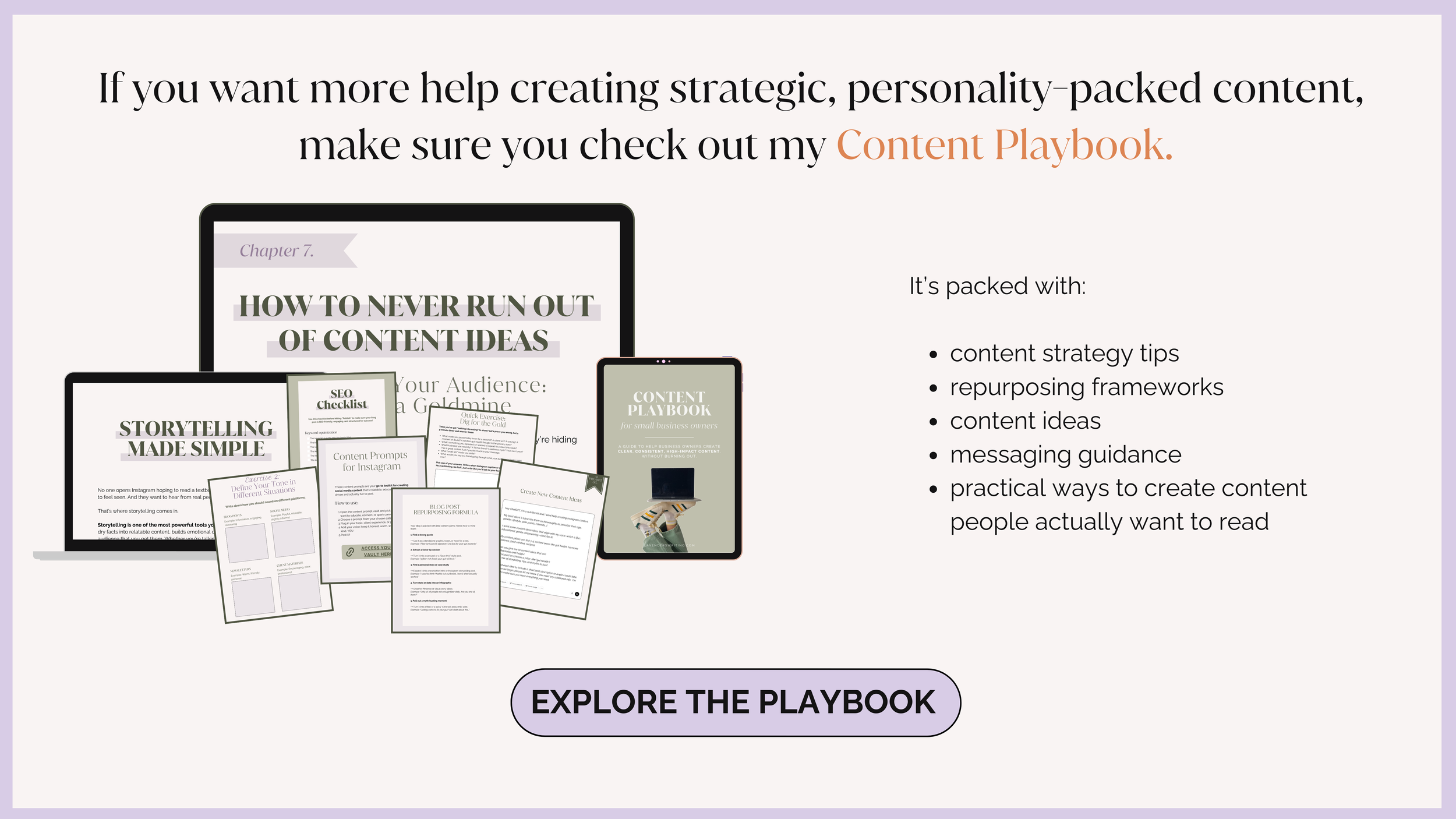
Here’s a repurposing formula from my Content Playbook that I LOVE using:
1. Find a strong quote
→ Use it as a standalone graphic, tweet, or hook for a reel.
Example: “Fiber isn’t just for digestion, it’s fuel for your gut bacteria.”
2. Extract a list or tip section
→ Turn it into a carousel or a “Save this!” style post.
Example: “5 fiber-rich foods your gut will love.”
3. Find a personal story or case study
→ Expand it into a newsletter intro or Instagram storytelling post.
Example: “I used to think I had to cut out bread… Here’s what actually worked.”
4. Turn stats or data into an infographic
→ Great for Pinterest or visual story slides.
Example: “Only 5% of people eat enough fiber daily. Are you one of them?”
5. Pull out a myth-busting moment
→ Turn it into a Reel or a spicy “Let’s talk about this” post.
Example: “Cutting carbs to fix your gut? Let’s talk about this…”
4. Use Blog Content to Build Topical Authority
One of the biggest benefits of having a blog content marketing strategy is that it helps establish topical authority.
Fancy marketing term. Simple concept.
The more consistently you talk about a specific topic, the easier it is for people (and search engines) to understand what you do.
Let's say you're a nutritionist. If your blog covers topics like gut health, blood sugar, digestion or meal planning, people quickly start connecting you with those topics.
The same goes for Google. And increasingly, the same goes for AI tools.
This is why random blogging rarely works particularly well. Publishing one blog about gut health, one about workplace productivity, one about your favorite coffee order and one about your cat's emotional support squirrel doesn't create a clear picture of your expertise. (Although I'd absolutely read that last one.)
A strong blog content marketing strategy helps you create content that's connected. Over time, those connections help search engines, AI tools and potential customers understand exactly what you do and who you help. And that's when your content starts working a lot harder for you.
5. Cross-Promote Your Business Through Blog Content
A lot of people treat blog posts like educational resources. And they are. But they're also an opportunity.
Your blog shouldn't just educate people. It should gently guide them toward the next step.
Not in a weird "Buy my stuff immediately" kind of way. More in a "Hey, if you found this helpful, here's what to do next" kind of way.
For example:
Service mention: mention your services when relevant
Free resource: add link to your freebie
Newsletter: invite readers to join your email list
Related content: link other related blog posts (good for SEO too)
Products: mention offers that solve the reader's problem
Let's say you're a virtual assistant writing a blog post about managing a busy schedule.
At the end of that blog, it makes sense to:
add link to your services page
recommend another blog about productivity or delegation
invite readers to download a free planning template
encourage them to join your newsletter for more business tips
Or maybe you're a nutritionist writing about healthy meal prep. You could:
add link to your nutrition coaching services
recommend a related blog about optimizing your cooking
add link to your freebie with weekly dinner recipes
invite readers to join your email list where you share more meal prep tips
See how naturally that fits?
If someone just spent ten minutes reading your content, there's a good chance they're interested in learning more. A strategic blog content marketing strategy helps you guide them toward the next logical step, whether that's another blog post, a free resource, your newsletter or one of your services.
Your Blog Shouldn't Be an Afterthought
The businesses seeing the best results from blogging aren't necessarily publishing every day. But they are focused on creating thoughtful content and finding multiple ways to use it throughout their marketing.
A single blog post can:
support SEO
improve AI visibility
build authority
create social media content
promote your services
answer customer questions
keep working long after you hit publish
Not bad for a few thousand words sitting on your website.
Don't Want to Write the Blogs Yourself? I Can Help
Yes, this is the part where I shamelessly promote my services
A lot of business owners know blogging is important…
They just don’t have time, hate writing. don’t understand SEO, don’t know what to write about, or would rather do literally anything else. And that’s completely fair.
That’s why I offer SEO blog writing services for small business owners who want:
personality-packed blogs
strategic keyword research
AI + search engine optimized content
blog topic ideas
clear readable formatting
content that actually sounds human
I offer blog packages, monthly blog subscriptions and ongoing SEO content support for businesses that want fresh, strategic content consistently, without having to become full-time writers themselves.
Monthly blog subscriptions are usually the smartest option because blogging works best when it’s consistent. One random blog post every seven months isn’t exactly a content strategy, but more like a cry for help.
Every blog I write includes keyword research, content strategy, SEO optimization and thoughtful, personality-driven writing designed to help your business get discovered through both Google and AI search tools.
So if you want blog content that’s strategic, searchable and actually enjoyable to read, you can check out my blog writing services here.